what kinds of geologic features form at subduction zones

Plot of the geological process of subduction
Subduction is a geological process in which the limitless geosphere is recycled into the Earth's mantle at focussed boundaries. Where the oceanic lithosphere of a tectonic plate converges with the little dense lithosphere of a second plate, the heavier plate dives to a lower place the second home base and sinks into the mantle. A region where this process occurs is known as a subduction zona, and its grade-constructed expression is known as an arc-ditch multiplex. The process of subduction has created most of the Earth's transcontinental crust.[1] Rates of subduction are typically measured in centimeters p.a., with the average grade of convergence existence approximately two to eight centimeters per year along most plate boundaries.[2]
Subduction is possible because the frosty oceanic lithosphere is slightly denser than the underlying asthenosphere, the hot, ductile layer in the upper mantle inherent the cold, rigid lithosphere. Once initiated, stable subduction is driven mostly by the negative buoyancy of the dense subducting lithosphere. The slab sinks into the mantle largely under its weightiness.[3]
Earthquakes are common along the subduction zone, and fluids free by the subducting shell trigger volcanism in the dominant plate. If the subducting plate sinks at a shallow angle, the overriding plate develops a belt of distortion characterized past crustal thickening, rafts building, and metamorphism. Subduction at a steeper lean against is characterised by the formation of back-arc basins.[4]
Subduction and plate tectonics [edit]


According to the possibility of shell tectonics, the Earth's lithosphere, its rigid outer shell, is broken into sixteen larger tectonic plates and some small plates. These are in slow-moving movement, due to convection in the underlying ductile mantle. This process of convection allows heat generated by hot decay to escape from the Globe's Interior Department.[5]
The lithosphere consists of the outermost palish crust plus the uppermost rigid portion of the mantle. Eastern Malayo-Polynesian lithosphere ranges in heaviness from evenhanded a few km for young lithosphere created at middle-ocean ridges to around 100 km (62 mi) for the oldest oceanic lithosphere.[6] Continental geosphere is in the lead to 200 km (120 mi) thick.[7] The lithosphere is relatively cold and strict compared with the underlying asthenosphere, and so tectonic plates move As solid bodies atop the asthenosphere. Individual plates often include both regions of the body of water lithosphere and continental geosphere.
Subduction zones are where the cold oceanic lithosphere sinks hindermost into the mantle and is recycled.[4] [8] They are found at confluent plate boundaries, where the Eastern Malayo-Polynesian geosphere of unity plate converges with the less dense lithosphere of another plate. The heavier pelagic geosphere is overridden by the prima edge of the other scale.[6] The overridden plate (the slab) sinks at an angle of approximately 25 to seventy-fivesome degrees to Earth's surface.[9] This sinking is driven by the temperature difference between the slab and the surrounding asthenosphere, A the colder sea geosphere has, on the average, a greater denseness.[6] Sediments and close to treed water are carried downwards aside the slab and recycled into the late mantle.[10]
Globe is soh far the only planet where subduction is well-known to occur, and subduction zones are its most important tectonic feature. Subduction is the thrust behind plate tectonic theory, and without it, tectonics could not occur.[11] Oceanic subduction zones are settled along 55,000 kilometre (34,000 nautical mile) of convergent plate margins,[12] almost equidistant to the accumulative 60,000 km (37,000 land mile) of mid-ocean ridges.[13]
Structure of subduction zones [edit]
Arc-trench interlinking [delete]
The surface expression of subduction zones are arc-deep complexes. On the ocean face of the tangled, where the subducting plate first approaches the subduction partition, there is often an satellite ditch high operating theatre outer trench swell. Here the home shallows slightly ahead plunging downwards, as a consequence of the rigidity of the crustal plate.[14] The point where the slab begins to plunge downwards is marked aside an oceanic entrench. Oceanic trenches are the deepest parts of the ocean trading floor.
On the far side the trench is the forearc percentage of the preponderating plate. Depending on sedimentation rates, the forearc may include an accretionary sub of sediments scraped off the subducting slab and accreted to the overriding plate. However, not all arc-trench complexes have an increasing wedge. Accretionary arcs have a well-developed forearc basin behind the accretionary wedge, while the forearc basin is poorly developed in non-increasing arcs.[15]
Beyond the forearc basin, volcanoes are found in long irons called volcanic arcs. The subducting basalt and sediment are normally rich in hydrated minerals and clays. In addition, deep quantities of water are introduced into cracks and fractures created as the subducting slab air embolism downward.[16] During the transition from basalt to eclogite, these hydrated materials analyze, producing copious quantities of H2O, which at so much great pressure and temperature exists as a supercritical fluid.[17] The supercritical piss, which is hot and more chirpy than the surrounding rock, rises into the superimposed mantle, where it lowers the melting temperature of the mantle rock musi, generating magma via flux melting.[18] The magmas, successively, lift as diapirs because they are less dense than the rocks of the mantle.[19] The mantle-derived magmas (which are at first volcanic rock in paper) can ultimately reach the Earth's surface, resultant in volcanic eruptions. The stuff composition of the erupting lava depends upon the degree to which the mantle-derived basalt interacts with (melts) Earth's crust Beaver State undergoes fractional crystallisation. Electric discharge volcanoes tend to produce dangerous eruptions because they are rich in water (from the slab and sediments) and incline to be extremely sudden.[20] Krakatoa, Nevado del Ruiz, and Climb Vesuvius are all examples of arc volcanoes. Arcs are also related with most ore deposits.[19]
On the far side the mount arc is a back-arc area whose character depends powerfully on the angle of subduction of the subducting slab. Where this tip is shallow, the subducting slab drags the superjacent continental crust, producing a zone of densification in which there may be extensive folding and thrust faulting. If the angle of subduction is deep, the crust will be insert tension instead, often producing a back-curve basin.[21]
Inscrutable structure [redact]
The arc-trench building complex is the come up expression of a very much deeper structure. Though not directly accessible, the deeper portions lav be premeditated victimisation geophysical science and geochemistry. Subduction zones are defined by an inclined partition of earthquakes, the Wadati–Benioff zone, that dips away from the trench and extends pop to the 660-kilometre discontinuity. Subduction zone earthquakes occur at greater depths (up to 600 km (370 international nautical mile)) than elsewhere on Land (typically less than 20 km (12 mi) depth); such deep earthquakes may be driven by deep phase transformations, thermal runaway, or dehydration embrittlement.[22] [23] Seismal tomography shows that some slabs can imbue the lower mantle[24] [25] and sink decipherable to the core–drapery bound.[26] Here the rest of the slabs may eventually heat enough to stand up backbone to the surface as mantle plumes.[27] [28]
Subduction angle [edit]
Subduction typically occurs at a passably steep angle properly at the point of the convergent plate boundary. However, anomalous shallower angles of subduction are known to exist as well as some that are extremely precipitous.[29]
- Flat-slab subduction (subducting tip over less than 30°) occurs when the slab subducts virtually horizontally. The relatively flat slab privy reach out for hundreds of kilometers. That is abnormal, as the dense slab typically sinks at a much steeper angle. Because subduction of slabs to depth is needed to drive subduction zona volcanism, flat-slab subduction can be invoked to explain volcanic gaps.
Flat-slab subduction is current beneath part of the Andes, causing segmentation of the Andean Extrusive Belt into four zones. The flat-slab subduction in blue Peru and the Norte Chico neighborhood of Chili pepper is believed to glucinium the result of the subduction of two chirpy aseismic ridges, the Nazca Ridge and the Juan Fernández Ridge, severally. Around Taitao Peninsula flat-slab subduction is attributed to the subduction of the Chile Hike, a spreading ridge.[30] [31]
The Laramide Orogeny in the Rocky Mountains of the United States is attributed to mat-slab subduction.[32] During this orogeny, a broad volcanic gap appeared at the southwestern margin of North America, and deformation occurred much further inland; information technology was during this time that the cellar-cored mountain ranges of Colorado River, UT, Wyoming, South Dakota, and New Mexico came into being. The nigh solid subduction district earthquakes, sol-called "megaquakes", have been found to occur in flat-slab subduction zones.[33]
- High-angle subduction (subducting slant greater than 70°) occurs in subduction zones where Earth's oceanic crust and lithosphere are grey-headed and thick and have, thence, lost buoyancy. The steepest dipping subduction geographical zone lies in the Mariana Trench, which is also where the oceanic crust, of Jurassic age, is the oldest happening Worldly concern exempting ophiolites. Steep-tilt subduction is, in contrast to unerect-slab subduction, associated with back-arc telephone extension[34] of gall, creating volcanic arcs and pulling fragments of continental crust away from continents to leave behind a marginal sea.
Life cycle of subduction zones [edit]
Origination of subduction [edit]
Although lasting subduction is within reason wellspring understood, the process by which subduction is initiated remains a matter of give-and-take and continuing subject area. Subduction can begin spontaneously if the denser oceanic lithosphere can laminitis and sink below the adjacent oceanic surgery geographical area geosphere through and through steep forcing only; alternatively, existing photographic plate motions can induce new subduction zones by horizontally forcing the oceanic lithosphere to rupture and sink into the asthenosphere.[35] [36] Both models can eventually yield self-sustaining subduction zones, every bit the pelagic crust is metamorphosed at great deepness and becomes denser than the surrounding mantle rocks. The compiling of subduction district initiation events back to 100 Ma suggests horizontally-forced subduction zone initiation for near modern subduction zones,[36] which is supported by results from quantitative models[37] [38] and geological studies.[39] [40] Some analogue modeling shows, however, the possibility of spontaneous subduction from inherent compactness differences between two plates at circumstantial locations like unresisting margins.[41] [42] There is evidence this has expropriated place in the Izu-Bonin-Mariana subduction arrangement.[43] [44] Earlier in Earth's history, subduction is likely to have initiated without naiant forcing referable the deficiency of relative dental plate motion, though an unorthodox proposal by A. Yin suggests that meteorite impacts may have contributed to subduction initiation along early Earth.[45]
End of subduction [blue-pencil]
Subduction can continue as long as the oceanic lithosphere moves into the subduction zone. Notwithstandin, the comer of chirpy crust at a subduction zone can result in its failure, by disrupting downwelling. The arrival of continental crust results in a hit or terrane accretion that disrupts subduction.[46] Landmass crust can subduct to depths of 100 km (62 mi) surgery more then again resurfaces.[47] [28] Sections of crustal Oregon intraoceanic arc crust greater than 15 km (9.3 mi) in thickness or oceanic plateau greater than 30 km (19 Secret Intelligence Service) in thickness can disrupt subduction. However, island arcs subducted conclusion-happening may movement only local disruption, piece an arc arriving parallel to the partition throne unopen it down.[46] This has happened with the Ontong Java Plateau and the Vitiaz Trench.[48]
Effects [edit]
Metamorphism [edit]
Subduction zones legion a unique assortment of rock types created by the high-pressure, low-temperature conditions a subducting slab encounters during its descent.[49] The metamorphic conditions the slab passes through in this process creates and destroys water bearing (hydrous) mineral phases, emotional body of water into the mantle. This weewe lowers the freezing point of mantle careen, initiating liquescent.[50] Understanding the timing and conditions in which these dehydration reactions go on, is key to interpreting mantle melting, volcanic arc magmatism, and the establishment of geographical region crust.[51]
A holometabolic facies is characterized by a balanced mineralized assemblage specific to a pressure-temperature range and specific starting material. Subduction zone metamorphism is characterized by a low gear temperature, high-ultrahigh pres metamorphic path through the zeolite, prehnite-pumpellyite, blueschist, and eclogite facies stability zones of subducted oceanic crust.[52] Zeolite and prehnite-pumpellyite facies assemblages may or may not be present, thus the onset of metamorphism May only be marked away blueschist facies conditions.[53] Subducting slabs are composed of basaltic crust topped with water sediments;[54] however, the pelagic sediments may live accreted onto the forearc-wall hanging surround and not subducted.[55] Most metamorphic phase transitions that occur within the subducting slab are prompted by the dehydration of hydrous petrified phases. The breakdown of hydrous mineral phases typically occurs at depths greater than 10 km.[56] All of these hemimetabolous facies is marked away the front of a specialised horse barn mineral gathering, transcription the metamorphic conditions undergone but the subducting slab. Transitions between facies causes hydrous minerals to dehydrate at certain pressure-temperature conditions and can therefore constitute tracked to melting events in the mantle at a lower place a mountain arc.
Volcanic bodily process [edit]
Volcanoes that occur above subduction zones, such as Climb up St. Helens, Get on Etna, and Fuji, rest approximately one hundred kilometers from the oceanic abyss in arcuate chains known as volcanic arcs. 2 kinds of arcs are loosely determined along Worldly concern: island arcs that form connected the body of water geosphere (for example, the Mariana and the Tonga island arcs), and continental arcs such as the Cascade Volcanic Discharge, that signifier along the coast of continents. Island arcs (intraoceanic operating room primitive arcs) are produced away the subduction of oceanic lithosphere beneath another oceanic lithosphere (ocean-ocean subduction) while landmass arcs (Mountain chain arcs) form during the subduction of unlimited geosphere beneath a continental lithosphere (ocean-continent subduction).[57] An example of a extrusive arc having some island and geographic region arc sections is plant buttocks the Aleutian Trench subduction zone in Alaska.[58]
The arc magmatism occurs c to two hundred kilometers from the trench and approximately one hundred kilometers above the subducting slab. This deepness of arch magma generation is the import of the interaction between hydrous fluids, discharged from the subducting slab, and the arc mantle hacek that is hot enough to melt with the addition of water.[59] It has besides been suggested that the commixture of fluids from a subducted tectonic dental plate and melted sediment is already occurring at the top of the slab in front any mixing with the mantle takes place.[60]
Arcs produce about 10% of the total volume of magma produced each year on Earth (approximately 0.75 cubic kilometers), much less than the volume produced at middle-sea ridges,[61] but they have got formed most continental encrustation.[4] Arc volcanism has the greatest impact on humans because many arc volcanoes lie above overseas level and erupt violently. Aerosols injected into the stratosphere during tearing eruptions can cause rapid cooling of Earth's climate and affect air go out.[59]
Earthquakes and tsunamis [edit]
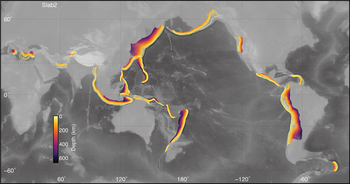
Global map of subduction zones, with subducted slabs contoured by depth
The strains caused away plate convergence in subduction zones cause at to the lowest degree three types of earthquakes. These are deep earthquakes, megathrust earthquakes, and outer rise earthquakes.
Anomalously deep events are a characteristic of subduction zones, which make the deepest quakes along the planet. Earthquakes are generally restricted to the shallow, brittle parts of the crust, generally at depths of to a lesser degree twenty kilometers. However, in subduction zones, quakes occur at depths as great as 700 kilometer (430 mi). These quakes define given zones of seismicity celebrated as Wadati–Benioff zones which trace the descending slab.[62]
Nine of the ten largest earthquakes of the last 100 years were subduction zone megathrust earthquakes, which included the 1960 Great Chilean temblor, which, at M 9.5, was the largest earthquake always recorded; the 2004 Indian Ocean earthquake and tsunami; and the 2011 Tōhoku earthquake and tsunami. The subduction of old Eastern Malayo-Polynesian crust into the mantle depresses the local geothermic gradient and causes a larger portion of Earth to deform in a more untempered fashion than it would in a normal geothermal gradient setting. Because earthquakes can pass off only a rock is deforming in a brittle style, subduction zones can cause large earthquakes. If such a quake causes rapid deformation of the sea trading floor, there is potential for tsunamis, such as the earthquake caused by subduction of the Indo-Australian Plate under the Euro-Asian Plate on December 26, 2004, that devastated the areas or so the Indian Ocean. Low tremors which cause small, nondamaging tsunamis, also occur often.[62]
A study published in 2016 suggested a new parameter to determine a subduction zone's power to generate mega-earthquakes.[63] By examining subduction zone geometry and comparing the degree of curvature of the subducting plates in enthusiastic historical earthquakes such as the 2004 Sumatra-Andaman and the 2011 Tōhoku earthquake, it was determined that the order of magnitude of earthquakes in subduction zones is inversely proportionate to the degree of the fault's curve, meaningful that "the flatter the contact between the two plates, the more than likely IT is that mega-earthquakes will occur."[64]
Outer rise earthquakes hap when normal faults oceanward of the subduction zone are activated by crease of the plate equally it bends into the subduction partition.[65] The 2009 Samoa seism is an lesson of this type of event. Supplanting of the sea floor caused away this event generated a six-meter tsunami in nearby Samoa.
Seismic imaging has helped notice subducted geosphere, slabs, deep in the curtain where there are no earthquakes. About one hundred slabs wealthy person been described in terms of astuteness and their timing and position of subduction.[66] The great seismic discontinuities in the mantle, at 410 klick (250 mi) deepness and 670 km (420 mi), are noncontinuous by the descent of cold slabs in deep subduction zones. Some subducted slabs appear to have difficulty penetrating the major discontinuity that marks the boundary 'tween the pep pill cape and turn down drape at a depth of most 670 kilometers. Other subducted oceanic plates suffer sunk to the core–mantle bound at 2890 klick profundity. More often than not, slabs decelerate during their descent into the mantle, from typically different cm/yr (adequate ~10 cm/yr in several cases) at the subduction partition and in the uppermost mantel, to ~1 cm/yr in the lower mantle.[66] This leads to either folding or stacking of slabs at those depths, visible Eastern Samoa thickened slabs in Seismic imaging. Below ~1700 kilometre, there power be a controlled quickening of slabs due to lower viscousness A a result of inferred mineral phase changes until they approach and finally stalling at the core–mantle boundary.[66] Here the slabs are hot by the ambient heat and are not heard anymore ~300 Myr subsequently subduction.[66]
Orogeny [edit]
Orogeny is the process of mountain building. Subducting plates can lead to orogeny by delivery oceanic islands, oceanic plateaus, and sediments to convergent margins. The material often does not subduct with the stay of the plate but alternatively is accreted (scraped off) to the Continent, resultant in exotic terranes. The collision of this oceanic material causes crustal thickening and mount-building. The accreted material is often referred to as an accretionary wedge or prism. These accretionary wedges can be known by ophiolites (uplifted ocean crust consisting of sediments, pillow basalts, sheeted dykes, gabbro, and peridotite).[67]
Subduction may also cause orogeny without bringing in oceanic material that collides with the preponderating continent. When the subducting plate subducts at a shallow lean on underneath a continent (something called "flat-slab subduction"), the subducting plate English hawthorn have enough traction on the bottom of the continent-wide plate to cause the upper home plate to contract to lead to folding, faulting, crustal deepening, and mountain building. Flat-slab subduction causes mountain edifice and volcanism moving into the chaste, away from the trench, and has been described in North US (i.e. Laramide orogeny), South America, and East Asia.[66]
The processes described above allow subduction to continue while mountain building happens more and more, which is in contrast to continent-continent hit orogeny, which frequently leads to the termination of subduction.
Beginnings of subduction on Earth [redact]
New-style subduction is defined by low geothermal gradients and the associated formation of high-pressure contemptible-temperature rocks much as eclogite and blueschist.[68] [69] As wel, rock assemblages named ophiolites, associated with modern-elan subduction, also indicate much conditions.[68] Eclogite xenoliths found in the North China Craton render manifest that fashionable-stylus subduction occurred at to the lowest degree as early every bit 1.8 Empire State of the South ago in the Paleoproterozoic Era.[68] Nevertheless, the eclogite itself was produced by oceanic subduction during the assembly of supercontinents at about 1.9–2.0 Ga.
Blueschist is a rock distinctive for latter-day-day subduction settings. The absence of blueschist older than Neoproterozoic reflects much magnesium-princely compositions of Terra firma's oceanic crust during that period.[70] These more magnesium-rich rocks metamorphose into greenschist at conditions when modern oceanic crust rocks transmute into blueschist.[70] The ancient magnesium-rich rocks mean that Earth's mantle was once hotter, merely not that subduction conditions were hotter. Previously, the lack of pre-Neoproterozoic blueschist was thought to indicate a assorted type of subduction.[70] Both lines of evidence controvert previous conceptions of new-style subduction having been initiated in the Neoproterozoic Era 1.0 Ga ago.[68] [70]
History of investigation [edit]
Plague Hammond Walther Richard Rudolf Hess, who during Mankind War II served in the United States Navy Reserve and became fascinated in the ocean floor, designed the Mid-Atlantic Ridge and proposed that hot molten rock was added to the crust at the ridge and dilated the seafloor outward. This theory was to become known Eastern Samoa seafloor spreading. Since the Earth's circumference has non changed over geologic time, Hess over that older seafloor has to be consumed somewhere else, and advisable that this process takes place at oceanic trenches, where the crust would cost melted and recycled in the Earth's mantle.[71]
In 1964, George I Plafker researched the Good Friday earthquake in Alaska. He concluded that the cause of the earthquake was a megathrust reaction in the Aleutian Oceanic abyss, a result of the Alaskan continent-wide crust overlapping the Peaceable oceanic impudence. This meant that the Ocean cheekiness was being involuntary downward, or subducted, beneath the American crust. The concept of subduction would play a role in the growth of the tectonics theory.[72]
First geologic attestations of the "subduct" words date to 1970,[73] In ordinary English language to subduct, or to subduce (from Latin subducere, "to lead away")[74] are transitive verbs requiring a dependent to perform an action along an object non itself, hither the lower plate, which has past been subducted ("abstracted"). The geological terminal figure is "exhausted," which happens the geological moment the let down plate slips under, even though it whitethorn persist for some time until its remelting and profligacy. Therein conceptual model, plate is continually beingness used up.[75] The individuality of the subject, the consumer, operating room agent of economic consumption, is left-hand unstated. Both sources accept this subject field-object retrace.
Geology makes to subduct into an intransitive verb form verb and a reflexive verb. The lower plate itself is the subject. Information technology subducts, in the sense of retirement, operating theater removes itself, and while doing so, is the "subducting plate." What is more, the word slab is specifically betrothed to the "subducting plate," even though in West Germanic language the upper plate is just arsenic much of a slab.[76] The upper plate is port hanging, so to speak. To express it geology moldiness switch to a opposite verb, typically to overturn. The speed plate, the subject, performs the action of overriding the object, the lower scale, which is overridden.[77]
Importance [edit]
Subduction zones are important for several reasons:
- Subduction zone physics: Sinking feeling of the oceanic lithosphere (sediments, crust, mantle), by the contrast of density between the cold and antique geosphere and the hot asthenospheric mantle wedge, is the strongest force (but not the only one) necessary to drive scale motion and is the dominant mode of mantle convection.
- Subduction zone chemistry: The subducted sediments and crust desiccate and bring out piss-rich (sedimentary) fluids into the overlying mantle, causing Mickey Mantle melting and fractionation of elements between the surface and abysmal mantle reservoirs, producing island arcs and continental crust. Hot fluids in subduction zones also alter the material compositions of the subducting sediments and potentially the habitability of the sediments for microorganisms.[78]
- Subduction zones weigh down subducted oceanic sediments, oceanic impudence, and mantle lithosphere that interact with the violent asthenospheric drapery from the complete-riding plate to produce calc-alkaline serial publication melts, ore deposits, and continental encrustation.
- Subduction zones pose significant threats to lives, property, economic vitality, cultural and natural resources, and quality of life. The tremendous magnitudes of earthquakes or unstable eruptions can also have belt-on effects with global impact.[79]
Subduction zones take up also been considered atomic number 3 possible disposal sites for nuclear squander in which the litigate of subduction itself would carry the material into the planetary mantle, safely by from any possible regulate happening humanity surgery the surface environment. However, that method of disposal is currently banned by planetary agreement.[80] [81] [82] [83] Furthermore, plate subduction zones are connected with very large megathrust earthquakes, making the effects of using any specific site for disposal unpredictable and mayhap adverse to the safety of long-term disposal.[81]
View also [edit]
- Densification simulation
- Divergent boundary – Linear feature that exists between two tectonic plates that are moving by from all other
- Divergent bivalent subduction – Tectonic process in which two parallel subduction zones with different directions are matured on the unchanged Eastern Malayo-Polynesian plate
- List of tectonic home base interactions – Definitions and examples of the interactions betwixt the relatively mobile sections of the lithosphere
- Obduction – Overthrusting of sea lithosphere onto Continental lithosphere at a convergent plate boundary
- Paired metamorphous belts – Sets of juxtaposed simple rock units that display contrasting metamorphic mineral assemblages
- Ring of Give the sack – Part more or less the brim of the Pacific Ocean where many volcanic eruptions and earthquakes occur
- Slab window – Type of gap in a subducted oceanic plate
- Wilson Cycle – Geophysical poser of the opening and terminative of rifts
References [edit]
- ^ Stern, Robert J. (2002), "Subduction zones", Reviews of Geophysics, 40 (4): 1012, Bibcode:2002RvGeo..40.1012S, Interior:10.1029/2001RG000108
- ^ Defant, M. J. (1998). Voyage of Discovery: From the Big Be intimate to the Glacial period. Mancorp. p. 325. ISBN978-0-931541-61-2.
- ^ Stern 2002, p. 3.
- ^ a b c Bottom 2002.
- ^ Schmincke, Hans-Ulrich (2003). Volcanism. Berlin: Springer. pp. 13–20. ISBN9783540436508.
- ^ a b c Bottom 2002, p. 5.
- ^ Rudnick, Roberta L.; McDonough, William F.; O'Connell, Richard J. (April 1998). "Thermal structure, thickness and composition of geographical area lithosphere". Material Geology. 145 (3–4): 395–411. Bibcode:1998ChGeo.145..395R. doi:10.1016/S0009-2541(97)00151-4.
- ^ Zheng, YF; Chen, YX (2016). "Continental versus oceanic subduction zones". National Science Review. 3 (4): 495–519. doi:10.1093/nsr/nww049.
- ^ Tovish, Aaron; Schubert, Gerald; Luyendyk, Bruce P. (10 Dec 1978). "Mantle course pressure and the angle of subduction: Non-Newtonian tree flows". Journal of Geophysical Research: Solid Terra firma. 83 (B12): 5892–5898. Bibcode:1978JGR....83.5892T. doi:10.1029/JB083iB12p05892.
- ^ Stern 2002, p. 15.
- ^ Stern 2002, pp. 1–4.
- ^ Lallemand, S (1999). La Subduction Oceanique (in French). Newark, Rising Jersey: Gordon and Breach.
- ^ Stark 2002, p. 4.
- ^ Whitman, Dean (May 1999). "The Isostatic Balance Gravity Anomaly of the Central Andes, 12° to 29° S: A Steer to Interpreting Crustal Structure and Deeper Lithospheric Processes". International Geology Review. 41 (5): 457–475. Bibcode:1999IGRv...41..457W. doi:10.1080/00206819909465152.
- ^ Stern 2002, pp. 25–26.
- ^ Fujie, Gou; et atomic number 13. (2013). "Systematic changes in the incoming plate structure at the Kuril trench". Geophysical Research Letters. 40 (1): 88–93. Bibcode:2013GeoRL..40...88F. doi:10.1029/2012GL054340.
- ^ Stern 2002, pp. 6–10.
- ^ Schmincke 2003, pp. 18, 113–126.
- ^ a b Stern 2002, pp. 19–22.
- ^ Stern 2002, p. 27-28.
- ^ Can 2002, p. 31.
- ^ Frolich, C. (1989). "The Nature of Bottomless Focus Earthquakes". Annual Brush up of Earth and Unsettled Sciences. 17: 227–254. Bibcode:1989AREPS..17..227F. doi:10.1146/annurev.Ea.17.050189.001303.
- ^ Hacker, B.; et al. (2003). "Subduction factory 2. Are intermediate-depth earthquakes in subducting slabs connected to metamorphic drying up reactions?" (PDF). Journal of Geophysical Research. 108 (B1): 2030. Bibcode:2003JGRB..108.2030H. Interior Department:10.1029/2001JB001129.
- ^ Domeier, Mathew; Doubrovine, Pavel V.; Torsvik, Trond H.; Spakman, Wim; Fuzz, Abigail L. (28 May 2016). "Global correlation of glower mantle structure and past subduction". Geophysical Explore Letters. 43 (10): 4945–4953. Bibcode:2016GeoRL..43.4945D. DoI:10.1002/2016GL068827. PMC6686211. PMID 31413424.
- ^ Faccenna, Claudio; Oncken, Onno; Holt, Adam F.; Becker, Thorsten W. (2017). "Initiation of the Andean orogeny by lower mantle subduction". Earth and Planetary Science Letters. 463: 189–201. Bibcode:2017E&PSL.463..189F. doi:10.1016/j.epsl.2017.01.041.
- ^ Hutko, Alexander R.; Lay, Thorne; Garnero, Edward J.; Revenaugh, Justin (2006). "Seismic detection of folded, subducted lithosphere at the core–mantle bounds". Nature. 441 (7091): 333–336. Bibcode:2006Natur.441..333H. doi:10.1038/nature04757. PMID 16710418. S2CID 4408681.
- ^ Li, Mingming; McNamara, Allen K. (2013). "The difficulty for subducted oceanic crust to accumulate at the Earth's core-mantle boundary". Journal of Geology Research: Solid Earth. 118 (4): 1807–1816. Bibcode:2013JGRB..118.1807L. doi:10.1002/jgrb.50156.
- ^ a b Stern 2002, p. 1.
- ^ Zheng, YF; Chen, RX; Xu, Z; Zhang, SB (2016). "The send on of water in subduction zones". Science China Globe Sciences. 59 (4): 651–682. Bibcode:2016ScChD..59..651Z. doi:10.1007/s11430-015-5258-4. S2CID 130912355.
- ^ Sillitoe, Richard H. (August 1974). "Tectonic partition of the Andes: implications for magmatism and metallogeny". Nature. 250 (5467): 542–545. Bibcode:1974Natur.250..542S. doi:10.1038/250542a0. S2CID 4173349.
- ^ Jordan, Agnes Gonxha Bojaxhi E.; Isacks, Bryan L.; Allmendinger, Richard W.; Beer maker, Jon A.; Ramos, Winner A.; Ando, Clifford J. (1 March 1983). "Andean architectonics related to geometry of subducted Nazca home". GSA Bulletin. 94 (3): 341–361. Bibcode:1983GSAB...94..341J. Department of the Interior:10.1130/0016-7606(1983)94<341:ATRTGO>2.0.CO;2.
- ^ W. P. Schellart; D. R. Stegman; R. J. Farrington; J. Freewoman & L. Moresi (16 July 2010). "Cenozoic Tectonics of Southwestern North America Controlled by Evolving Breadth of Farallon Slab". Science. 329 (5989): 316–319. Bibcode:2010Sci...329..316S. Department of the Interior:10.1126/skill.1190366. PMID 20647465. S2CID 12044269.
- ^ Bletery, Quentin; Thomas the doubting Apostle, Amanda M.; Rempel, Alan W.; Karlstrom, Leif; Sladen, Anthony; Delaware Barros, Louis (2016-11-24). "Fault curvature English hawthorn control where big quakes occur, Eurekalert 24-Nov-2016". Science. 354 (6315): 1027–1031. Bibcode:2016Sci...354.1027B. Department of the Interior:10.1126/science.aag0482. PMID 27885027. Retrieved 2018-06-05 .
- ^ Lallemand, Serge; Heuret, Arnauld; Boutelier, David (8 September 2005). "On the relationships between slab dip, back-arc stress, upper dental plate absolute motion, and crustal nature in subduction zones" (PDF). Geochemistry, Geophysics, Geosystems. 6 (9): Q09006. Bibcode:2005GGG.....609006L. doi:10.1029/2005GC000917.
- ^ Stern, R.J. (2004). "Subduction initiation: spontaneous and induced". Earth and Planetary Science Letters. 226 (3–4): 275–292. Bibcode:2004E&PSL.226..275S. doi:10.1016/j.epsl.2004.08.007.
- ^ a b Crameri, Fabio; Magni, Valentina; Domeier, Mathew; Shephard, Ornament E.; Chotalia, Kiran; Cooper, George; Eakin, Caroline M.; Grima, Antoniette Greta; Gürer, Derya; Király, Ágnes; Mulyukova, Elvira (2020-07-27). "A transdisciplinary and community of interests-driven database to unravel subduction zone initiation". Nature Communications. 11 (1): 3750. Bibcode:2020NatCo..11.3750C. Interior Department:10.1038/s41467-020-17522-9. ISSN 2041-1723. PMC7385650. PMID 32719322.
- ^ Hall, C.E.; et al. (2003). "Catastrophic initiation of subduction following forced convergence across fracture zones". Earth and Global Science Letters. 212 (1–2): 15–30. Bibcode:2003E&PSL.212...15H. doi:10.1016/S0012-821X(03)00242-5.
- ^ Gurnis, M.; et al. (2004). "Evolving force-out balance during inchoate subduction". Geochemistry, Geophysics, Geosystems. 5 (7): Q07001. Bibcode:2004GGG.....5.7001G. doi:10.1029/2003GC000681.
- ^ Keenan, Timothy E.; Encarnación, John; Buchwaldt, Robert; Fernandez, Dan; Mattinson, St. James the Apostl; Rasoazanamparany, Christine; Luetkemeyer, P. Benjamin (2016). "Rapid conversion of an oceanic scattering center to a subduction zone inferred from shrill-preciseness geochronology". PNAS. 113 (47): E7359–E7366. Bibcode:2016PNAS..113E7359K. doi:10.1073/pnas.1609999113. PMC5127376. PMID 27821756.
- ^ House, M. A.; Gurnis, M.; Kamp, P. J. J.; Sutherland, R. (September 2002). "Uplift in the Fiordland Region, New Zealand: Implications for Incipient Subduction" (PDF). Science. 297 (5589): 2038–2041. Bibcode:2002Sci...297.2038H. doi:10.1126/science.1075328. PMID 12242439. S2CID 31707224.
- ^ Mart, Y., Aharonov, E., Mulugeta, G., Ryan, W.B.F., Tentler, T., Goren, L. (2005). "Analog mould of the origination of subduction". Geophys. J. Int. 160 (3): 1081–1091. Bibcode:2005GeoJI.160.1081M. doi:10.1111/j.1365-246X.2005.02544.x. CS1 maint: binary names: authors list (link)
- ^ Goren, L.; E. Aharonov; G. Mulugeta; H. A. Koyi; Y. Mart (2008). "Manipulable Distortion of Passive Margins: A New Mechanism for Subduction Initiation". J. Geophys. RES. 113: B08411. Bibcode:2008JGRB..11308411G. doi:10.1029/2005JB004179. S2CID 130779676.
- ^ Stern, R.J.; Bloomer, S.H. (1992). "Subduction partition early childhood: examples from the Eocene Izu-Bonin-Mariana and Jurassic California arcs". Geological Society of U.S. Bulletin. 104 (12): 1621–1636. Bibcode:1992GSAB..104.1621S. doi:10.1130/0016-7606(1992)104<1621:SZIEFT>2.3.CO;2.
- ^ Arculus, R.J.; et al. (2015). "A immortalis of spontaneous subduction foundation in the Izu–Bonin–Mariana arc" (PDF). Nature Geoscience. 8 (9): 728–733. Bibcode:2015NatGe...8..728A. doi:10.1038/ngeo2515.
- ^ Yin, A. (2012). "An episodic slab-rollback model for the blood of the Tharsis rise on Mars: Implications for induction of local home plate subduction and final unification of a kinematically linked global plate-scientific discipline net on Earth". Geosphere. 4 (6): 553–593. Bibcode:2012Lsphe...4..553Y. DoI:10.1130/L195.1.
- ^ a b Stern 2002, pp. 6–7.
- ^ Ernst, W. G. (June 1999). "Metamorphism, partial preservation, and exhumation of ultrahigh‐pressure belts". Island Arc. 8 (2): 125–153. doi:10.1046/j.1440-1738.1999.00227.x.
- ^ Cooper, P. A.; Taylor, B. (1985). "Polarity volte-face in the Solomon Islands arc" (PDF). Nature. 314 (6010): 428–430. Bibcode:1985Natur.314..428C. doi:10.1038/314428a0. S2CID 4341305. Retrieved 4 December 2020.
- ^ Zheng, Y.-F., Chen, Y.-X., 2016. Continental versus oceanic subduction zones. National Science Followup 3, 495-519.
- ^ "How Volcanoes work – Subduction Geographical zone Volcanism". San Diego State University Department of Geological Science.
- ^ Mibe, Kenji; et Alabama. (2011). "Slab thaw versus slab dehydration in subduction zones". Proceeding of the National Academy of Sciences. 108 (20): 8177–8182. DoI:10.1073/pnas.1010968108. PMC3100975. PMID 21536910.
- ^ Zheng, Y.-F., Chen, R.-X., 2017. Territorial metamorphism at extreme conditions: Implications for orogeny at convergent plate margins. Diary of Asiatic Earth Sciences 145, 46-73.
- ^ Winter, John D. (2010). Principles of Igneous and Metamorphic Petrology. Prentice Hall. pp. 541–548. ISBN978-0-321-59257-6.
- ^ Reynolds, Stephen (2012-01-09). Exploring Geology. John McGraw-Benny Hill. p. 124. ISBN978-0073524122.
- ^ Bebout, Grey E. (May 31, 2007). "Hemimetamorphic Chemical Geodynamics of Subduction". Earth and Planetary Science Letters. 260: 375. Bibcode:2007E&PSL.260..373B. doi:10.1016/j.epsl.2007.05.050.
- ^ Peacock, Simon M. (1 January 2004). "Thermal Anatomical structure and Metamorphic Evolution of Subducting Slabs". In Eiler, John (ed.). Inside the subduction factory. Geophysical Monograph Series. 138. Dry land Geology Union. pp. 12–15. ISBN9781118668573.
- ^ Stern 2002, pp. 24–25.
- ^ Carver, Gary; Plafker, George (19 March 2013). "Paleoseismicity and Neotectonics of the Aleutian Subduction Zone-An Overview". Geophysical Monograph Serial publication: 43–63. doi:10.1029/179GM03. ISBN9781118666395.
- ^ a b Exacting 2002, pp. 27–31.
- ^ "Volcanic arcs form past deep melting of rock mixtures: Study changes our understanding of processes inside subduction zones". ScienceDaily . Retrieved 2017-06-21 .
- ^ Fisher, Richard V.; Schmincke, H.-U. (1984). Pyroclastic rocks. Berlin: Springer spaniel-Verlag. p. 5. ISBN3540127569.
- ^ a b Stern 2002, pp. 17–18.
- ^ Bletery, Quentin; Thomas, Amanda M.; Rempel, Alan W.; Karlstrom, Leif; Sladen, Anthony; Barros, Louis Delaware (2016-11-25). "Mega-earthquakes rupture flat megathrusts". Science. 354 (6315): 1027–1031. Bibcode:2016Sci...354.1027B. doi:10.1126/science.aag0482. ISSN 0036-8075. PMID 27885027.
- ^ "Subduction zone geometry: Mega-earthquake risk indicator". ScienceDaily . Retrieved 2017-06-21 .
- ^ Garcia-Castellanos, D.; M. Torné; M. Fernàndez (2000). "Slab pull effects from a flexural analysis of the Tonga and Kermadec Trenches (Pacific Photographic plate)". Geophys. J. Int. 141 (2): 479–485. Bibcode:2000GeoJI.141..479G. doi:10.1046/j.1365-246x.2000.00096.x.
- ^ a b c d e "Atlas of the Infernal region | Van der Meer, D.G., van Hinsbergen, D.J.J., and Spakman, W., 2017, Atlas of the Underworld: slab remnants in the mantle, their sinking feeling history, and a early lookout happening get down mantle viscousness, Tectonophysics". www.atlas-of-the-underworld.org . Retrieved 2017-12-02 .
- ^ Matthews, John A., ed. (2014). Encyclopedia of Environmental Change. 1. City of the Angels: SAGE Reference.
- ^ a b c d Xu, Cheng; Kynický, Jindřich; Song, Wenlei; Taoist, Renbiao; Lü, Zeng; Atomic number 3, Yunxiu; Yang, Yueheng; Miroslav, Pohanka; Galiova, Michaela V.; Zhang, Lifei; Fei, Yingwei (2018). "Cold deep subduction recorded by remnants of a Paleoproterozoic carbonated slab". Nature Communications. 9 (1): 2790. Bibcode:2018NatCo...9.2790X. doi:10.1038/s41467-018-05140-5. PMC6050299. PMID 30018373.
- ^ Austere, Robert J. (2005). "Evidence from ophiolites, blueschists, and ultrahigh-pressure metamorphic terranes that the modern episode of subduction tectonics began in Neoproterozoic clock". Geology. 33 (7): 557–560. Bibcode:2005Geo....33..557S. doi:10.1130/G21365.1. S2CID 907243.
- ^ a b c d Palin, Richard M.; White, Richard W. (2016). "Emergence of blueschists on Worldly concern linked to secular changes in oceanic crust composition". Nature Geoscience. 9 (1): 60. Bibcode:2016NatGe...9...60P. Department of the Interior:10.1038/ngeo2605.
- ^ Wilson, J. Tuzo (December 1968). "A Revolution in Earth Science". Geotimes. WA DC. 13 (10): 10–16.
- ^ Geological Guild of America (July 6, 2017). "Geological Gild of America honors Excellency in Geoscience for 2017" (Press spill). Eurekalert!.
- ^ "subduction". Online Etymology Lexicon . Retrieved 31 December 2020.
- ^ John Ogilvie; Charles I Annandale (1883). "Subduce, Subduct". Imperial Dictionary of the West Germanic language Language. Intensity IV Shriek-Zythus (New Edition Carefully Reviewed and Greatly Increased ed.). London: Blackie &ere; Son.
- ^ "What is a tectonic plate?". U.S. Geological Survey (USGS). 1999.
- ^ "Subduction Zone". Database of Individual Seismogenic Sources (Insult). Istituto Nazionale di Geofisica e Vulcanologia (INGV). Retrieved 4 January 2021.
- ^ Schultz, C. (2015). "Overriding plate's properties affect subduction". Eos. 96. Interior:10.1029/2015EO026911.
- ^ Tsang, Man-Yin; Bowden, Sir Leslie Stephen A.; Wang, Zhibin; Mohammed, Abdalla; Tonai, Satoshi; Muirhead, David; Yang, Kiho; Yamamoto, Yuzuru; Kamiya, Nana; Okutsu, Natsumi; Hirose, Takehiro (2020-02-01). "Hot fluids, burial metamorphism and thermal histories in the underthrust sediments at IODP 370 site C0023, Nankai Increasing Complex". Marine and Petroleum Geology. 112: 104080. doi:10.1016/j.marpetgeo.2019.104080. ISSN 0264-8172.
- ^ "USGS publishes a new blueprint that can help make subduction zone areas more resilient". www.usgs.gov . Retrieved 2017-06-21 .
- ^ Hafemeister, St. David W. (2007). Physics of societal issues: calculations on national security, environment, and energy. Berlin: Impost Scientific discipline & Business Media. p. 187. ISBN978-0-387-95560-5.
- ^ a b Kingsley, Marvin G.; Rogers, Kenneth H. (2007). Calculated risks: highly hot waste and homeland security. Aldershot, Hants, England: Ashgate. pp. 75–76. ISBN978-0-7546-7133-6.
- ^ "Dumping and Loss overview". Oceans in the Nuclear Age. Archived from the pilot along June 5, 2011. Retrieved 18 Sept 2010.
- ^ "Computer storage and Disposal Options. World Nuclear Formation (date unknown)". Archived from the original on July 19, 2011. Retrieved February 8, 2012.
what kinds of geologic features form at subduction zones
Source: https://en.wikipedia.org/wiki/Subduction

Posting Komentar untuk "what kinds of geologic features form at subduction zones"